

Securing Residential Development Funding in the UK: A Developer Money Market Guide
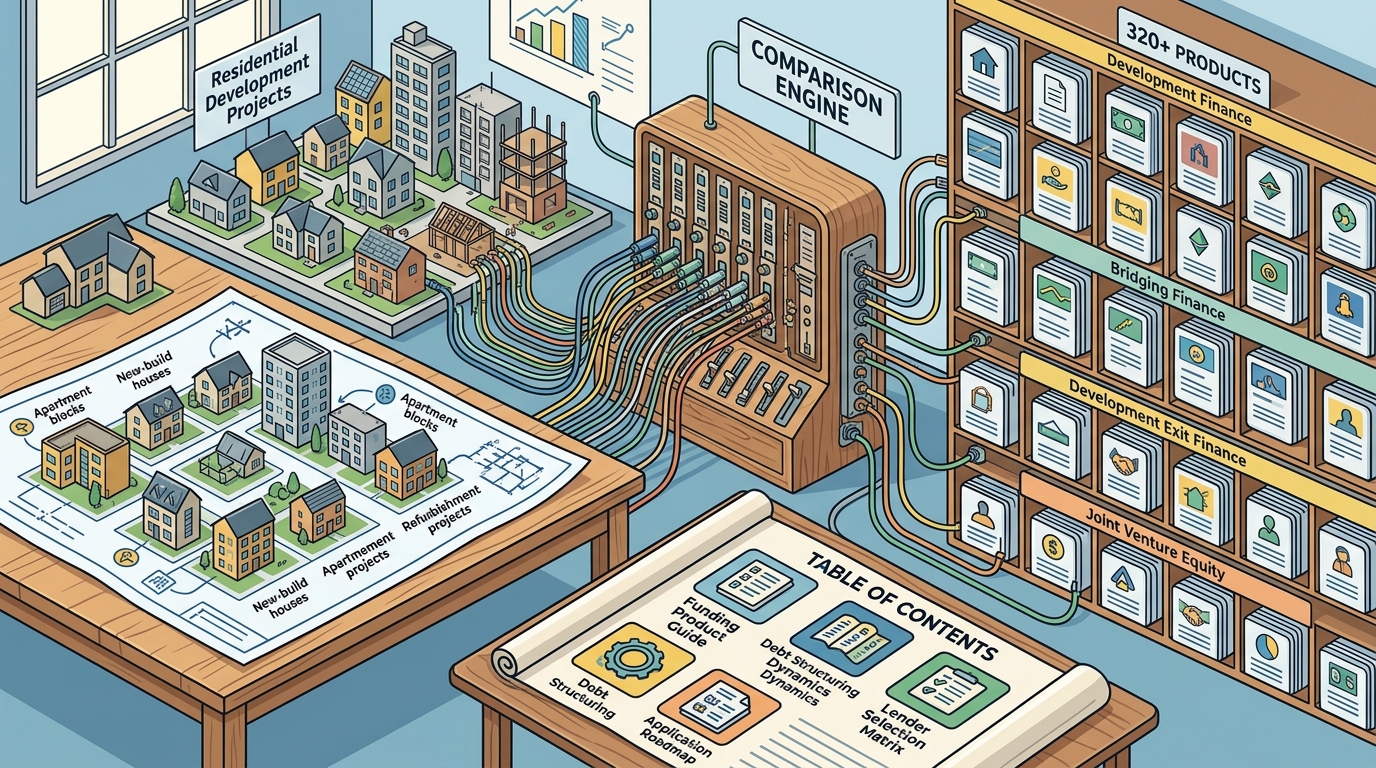
Developer Money Market helps UK residential developers secure funding by matching their specific project requirements with over 320 specialist loan products from more than 120 lenders. This guide explains how our independent brokerage service simplifies the search for development finance, bridging loans, and joint venture equity. We cover the core funding products available, the mechanics of debt structuring, and the practical steps to navigate the UK lending landscape efficiently.
Development Finance Products
Property development finance is a short-term loan designed to fund the acquisition, construction, and exit of a real estate project. For residential developers, the right product depends on the project stage, risk profile, and available equity. Developer Money Market provides access to a wide panel of lenders offering tailored solutions for new builds, conversions, and refurbishments across England, Wales, Scotland, and Northern Ireland.
Senior Development Loans
Senior debt is the primary source of funding for most residential projects. These facilities typically cover 60% to 80% of the total project cost or Gross Development Value (GDV). Lenders assess the project based on the developer's track record, planning permission status, and the viability of the end product. Our platform allows you to compare senior loan terms instantly, filtering by facility size, loan-to-value (LTV) ratios, and regional availability. This ensures you identify lenders whose criteria align with your specific site and build scope.
Bridging and Refurbishment Finance
Bridging finance is a fast, short-term loan used to secure a property or site before long-term development funding is arranged. It is particularly useful for auction purchases, chain breaks, or light refurbishment projects. Bridging loans are secured against the property and typically run for three to twelve months. Developer Money Market connects developers with specialist bridging lenders who can provide rapid agreement in principle. This speed is critical when competing for off-market sites or meeting tight completion deadlines at auction.
Development Exit Finance
Development exit finance is a short-term facility used to repay a development loan once the scheme is complete or near completion. It allows developers to release equity ahead of the final sale or refinance of individual units. This product helps manage cash flow and reduces holding costs during the marketing and sales phase. By structuring an exit facility, developers can avoid early repayment penalties on their main development loan and maintain flexibility in their sales strategy.
Debt Structuring Options
Debt structuring is the process of arranging multiple funding sources to meet the total capital requirements of a development project. A well-structured capital stack balances risk, cost, and control. Developer Money Market assists developers in designing these structures, ensuring that each layer of debt aligns with the project's financial model and the lender's risk appetite.
Joint Venture and Equity Partnerships
A joint venture (JV) is a partnership between a developer and an equity investor where both parties contribute resources to the project. The developer typically brings the project concept, planning, and management skills, while the investor provides the cash for acquisition and construction. In exchange for their capital, the equity partner receives an agreed share of the net profit. JV arrangements can provide 100% of the project funding, which is ideal for developers who have a strong site but limited available cash. Developer Money Market can introduce you to equity investors who specialize in residential developments, helping you structure a deal that protects your profit margin while securing the necessary capital.
Mezzanine and Stretch Finance
Mezzanine finance is a form of debt that sits between senior debt and equity in the capital stack. It is more expensive than senior debt but less dilutive than equity. Mezzanine lenders accept a higher risk in exchange for higher interest rates or a share of the upside. Stretch finance is a similar concept, allowing developers to borrow a higher percentage of the project cost than standard senior lenders would permit. These products are useful when a project is viable but requires more capital than the developer can raise through traditional senior debt alone. By using mezzanine or stretch finance, developers can maintain a higher equity stake in the project while still securing the full funding required.
Optimizing the Capital Stack
The goal of debt structuring is to minimize the overall cost of capital while maximizing the developer's return. This involves carefully balancing the proportion of senior debt, mezzanine finance, and equity. Developer Money Market's team works with you to model different funding scenarios. We analyze the impact of interest rates, fees, and profit splits on your bottom line. This data-driven approach ensures that your funding structure is robust and resilient to market changes.
| Funding Type | Typical LTV | Term | Primary Use Case |
|---|---|---|---|
| Senior Development Loan | 60% - 80% | 12 - 36 months | Main construction and acquisition funding |
| Bridging Loan | 50% - 85% | 3 - 12 months | Auction purchases, chain breaks, short-term holds |
| Mezzanine Finance | Varies | 12 - 24 months | Bridging the gap between senior debt and equity |
| Joint Venture Equity | 100% (with senior debt) | Project duration | Full funding for developers with limited cash |
Key Takeaways
- Developer Money Market provides access to over 320 loan products from more than 120 specialist lenders.
- Senior development loans typically cover 60% to 80% of project costs and are the backbone of most residential schemes.
- Bridging finance offers speed and flexibility for time-sensitive transactions like auction purchases.
- Joint ventures allow developers to secure 100% funding by partnering with equity investors.
- Mezzanine and stretch finance can help developers maintain higher equity stakes in their projects.
- Professional deal packaging is crucial for improving lender response times and securing better terms.
- Our independent brokerage service has no upfront fees and does not affect your credit score.
- Developer Money Market is a proud member of the NACFB, ensuring high standards of professionalism and transparency.
Frequently Asked Questions
What is the minimum loan size for residential development finance?
Minimum loan sizes vary by lender and product type. Some specialist lenders offer facilities starting from over £25,000, while others require a minimum of £100,000 or more. Developer Money Market's online platform allows you to filter by facility size to find lenders that match your project scale.
Do I need a track record as a developer to get funding?
While an experienced track record is advantageous, it is not always mandatory. Some lenders are willing to fund first-time developers if the project is well-structured, has planning permission, and is supported by a strong equity partner or JV. Developer Money Market can help you identify lenders who are open to first-time developers.
How long does it take to secure development finance?
The timeline depends on the complexity of the project and the lender's underwriting process. Bridging loans can be agreed in principle within days, while senior development loans may take several weeks. Using a broker like Developer Money Market can speed up the process by packaging your application professionally and targeting the right lenders.
What is the difference between regulated and unregulated development finance?
Regulated finance is typically for residential properties where the borrower or their family may occupy the property. Unregulated finance is for commercial or investment properties where no one occupies the property. Most development finance is unregulated. Developer Money Market is an unregulated introduction specialist and works with FCA-authorized broker partners for regulated lending.
Can Developer Money Market help with land acquisition finance?
Yes, we can help you secure funding for land acquisition. Bridging loans are commonly used to purchase land before planning permission is obtained. Once planning is secured, the bridging loan can be refinanced with a senior development loan to commence construction.
What fees are associated with using Developer Money Market?
There are no upfront fees for using our service. We are paid a success-only fee by the lender if your application is successful. The specific fee structure is disclosed to you throughout the process, ensuring full transparency.
How does Developer Money Market protect my data?
Your data is kept private and secure. Our website uses SSL encryption, and we do not share your information with lenders unless you explicitly select them for your application. You can manage and update your project details securely through your online account.
Conclusion
Securing funding for a residential development project in the UK requires a clear understanding of the available products and a strategic approach to debt structuring. Developer Money Market simplifies this process by providing access to a vast network of specialist lenders and offering expert guidance on deal packaging and capital stack optimization. Whether you need senior development finance, bridging loans, or joint venture equity, our independent brokerage service is designed to help you find the right funding solution for your project. To start your search, or use our online loan search platform to compare lenders instantly.