

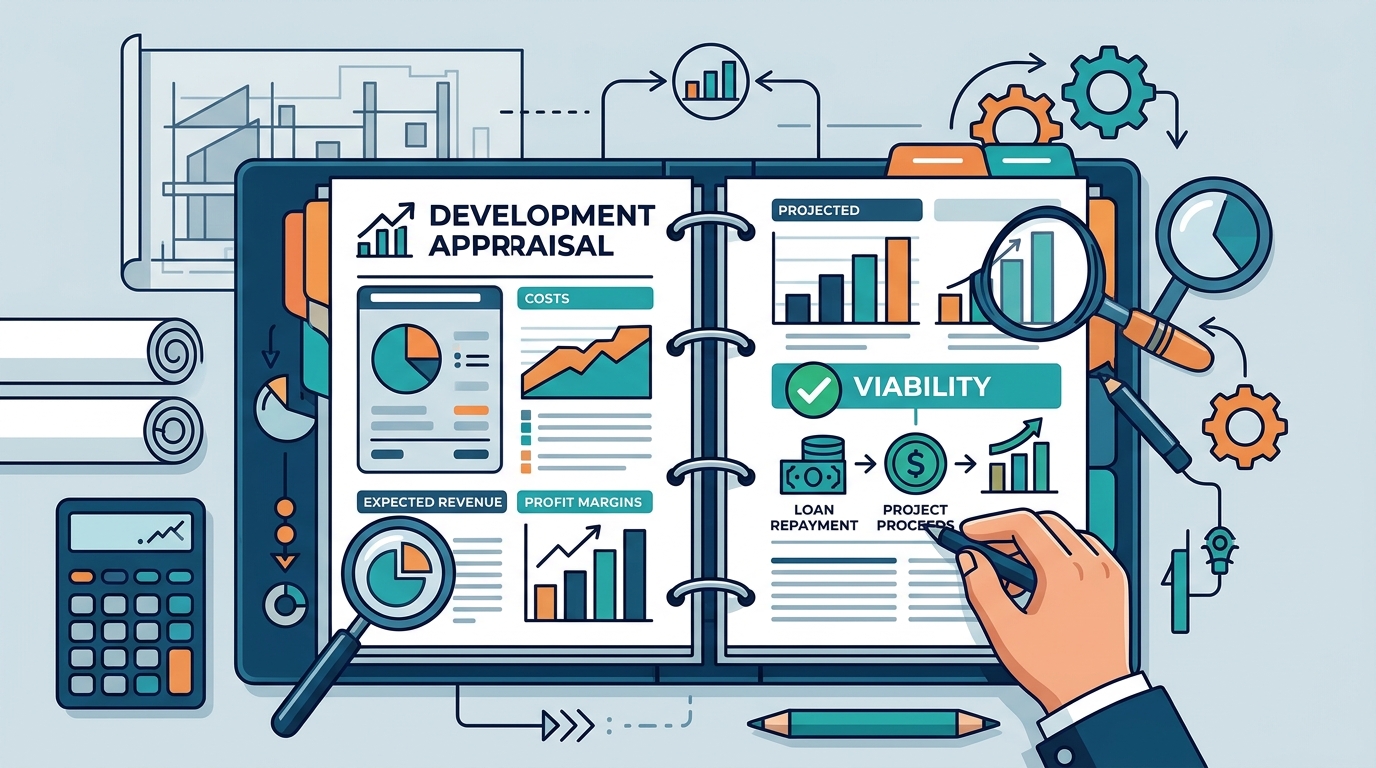
Development appraisal is a detailed financial model that projects the costs, revenues, and profit margins of a property project. Lenders require this document to verify that the project is viable and that the loan can be repaid from the projected sale or refinance proceeds. Without a robust appraisal, even a prime location may result in a declined application. Developer Money Market helps developers structure these documents to meet the strict underwriting standards of specialist lenders across the UK. according to Federal Register Disclosure
The Core Financial Model
The heart of any development appraisal is the cash flow projection. This section must clearly outline the total development cost (TDC), which includes land acquisition, construction costs, professional fees, and contingency. Lenders scrutinize the exit value, which is the projected value of the completed asset. A common metric used is the gross development profit (GDP), which is the difference between the exit value and the TDC. If the GDP is too low, the lender may view the project as too risky. Developer Money Market advises clients to ensure their models include a realistic contingency, typically between 5% and 10% of construction costs, to account for unforeseen expenses.
Supporting Technical Documentation
Financial projections are only as good as the technical data behind them. Lenders expect to see a detailed cost plan prepared by a quantity surveyor. This document breaks down construction costs into specific elements, such as substructure, superstructure, and finishes. It provides a level of detail that a simple spreadsheet cannot. Additionally, a planning statement or planning permission letter is essential. This confirms that the project has the necessary legal consent to proceed. Without valid planning permission, the lender cannot underwrite the project. For complex sites, a planning risk assessment may also be required to address any potential objections or conditions. according to Loan Documentation Minority For additional details, review the developermoneymarket com.
Market Evidence and Exit Strategy
Lenders need proof that the projected exit value is realistic. This is where market evidence comes in. A comparative market analysis (CMA) should include recent sales data for similar properties in the same area. This data helps validate the assumed sale price or rental income. The exit strategy must be clearly defined. Is the project intended for sale, refinance, or hold? Each strategy has different implications for the lender. For example, a sale exit requires evidence of market demand, while a refinance exit requires evidence of long-term income stability. Developer Money Market works with developers to ensure their exit strategies are supported by solid market data, reducing the risk of valuation disputes during underwriting.
Legal and Regulatory Compliance
Legal due diligence is a critical component of the appraisal package. A legal report from a solicitor confirms the title to the land and identifies any restrictions, covenants, or easements that could affect the project. This report also checks for any outstanding charges or liens on the property. In addition, environmental reports are often required, especially for brownfield sites. These reports assess the risk of contamination and the cost of remediation. Lenders are particularly sensitive to environmental liabilities, as they can significantly impact the project's viability. Ensuring that all legal and regulatory documents are up to date and comprehensive is essential for a smooth approval process.
Common Documentation Pitfalls
Many developers make the mistake of submitting incomplete or inconsistent documentation. For example, the cost plan may not align with the financial model, leading to confusion and delays. Another common issue is the lack of a clear contingency strategy. Lenders want to see how the project will handle cost overruns or market downturns. A sensitivity analysis, which shows how the project performs under different scenarios, can be very helpful. Developer Money Market reviews these documents to ensure consistency and completeness, helping developers avoid common pitfalls that lead to declined applications. according to Loan Documentation Minority
Key Takeaways
- Development appraisal is a financial model that projects costs, revenues, and profit margins. according to Federal Register Disclosure
- The total development cost (TDC) and exit value are the core components of the appraisal.
- A detailed cost plan from a quantity surveyor is essential for validating construction costs.
- Market evidence, such as a comparative market analysis, supports the projected exit value.
- Legal and environmental reports are required to confirm title and assess risk.
- Consistency between the cost plan and financial model is critical for lender approval.
- Developer Money Market helps developers structure these documents to meet lender standards.
Frequently Asked Questions
What is a development appraisal?
A development appraisal is a financial model that projects the costs, revenues, and profit margins of a property project. It is used by lenders to assess the viability of the project and the ability to repay the loan.
Why do lenders require a detailed cost plan?
Lenders require a detailed cost plan to verify that the construction costs are realistic and comprehensive. It provides a breakdown of costs by element, which helps identify potential risks and overruns.
What is the role of market evidence in a development appraisal?
Market evidence, such as a comparative market analysis, supports the projected exit value. It provides data on recent sales or rental income for similar properties, helping lenders validate the assumed sale price or income.
How important is the exit strategy in a development appraisal?
The exit strategy is critical because it defines how the loan will be repaid. Whether the project is intended for sale, refinance, or hold, the strategy must be clearly defined and supported by market data.
What legal documents are required for a development appraisal?
Legal documents include a legal report from a solicitor, which confirms title to the land and identifies any restrictions or charges. Environmental reports may also be required, especially for brownfield sites.
How can Developer Money Market help with development appraisal documentation?
Developer Money Market helps developers structure their appraisal documents to meet the strict underwriting standards of specialist lenders. They review the financial model, cost plan, and market evidence to ensure consistency and completeness.
Conclusion
Submitting a comprehensive and consistent development appraisal is essential for securing property development finance. Lenders rely on detailed financial models, cost plans, market evidence, and legal documents to assess the viability of a project. By ensuring that all documentation is accurate and aligned, developers can improve their chances of approval and secure competitive funding. Developer Money Market provides expert guidance to help developers navigate this process, connecting them with specialist lenders who understand the nuances of development finance. To plan your visit, .