

Getting property development finance is rarely just a matter of finding a lender with the lowest headline rate. The strongest applications usually come from projects that are clearly costed, realistically valued, supported by credible professionals, and matched with a lender whose criteria fit the site, borrower, location, and exit strategy.
For UK developers, the most effective route is normally to prepare the scheme first, define the funding gap, then approach a specialist property finance broker or lender with a complete and commercially credible proposal. Developer Money Market is an independent finance broker based in Chester, helping developers, investors, and housebuilders source funding across England, Wales, Scotland, and Northern Ireland. Its website states that the business works with more than 120 specialist lenders and has access to over 320 development, bridging, development exit, and joint venture products. ([developermoneymarket.com](https://www.developermoneymarket.com/?utm_source=openai))
This guide explains how to improve your chances of securing suitable finance, how different funding layers work, which documents lenders usually expect, and how to avoid common mistakes that can make a viable development appear too risky.
1. Start with the project, not the finance product
A common mistake is to begin by asking, “Which loan can I get?” A better question is, “What does this project require at each stage, and how will the lender be repaid?” The answers determine whether the appropriate solution is senior development finance, stretch senior finance, mezzanine funding, a joint venture, bridging finance, development exit finance, or a combination of facilities.
Development finance is generally short- to medium-term funding used to acquire land or property and pay for construction, conversion, refurbishment, professional fees, and other eligible project costs. It is different from a standard residential mortgage because the lender assesses the development appraisal, the projected Gross Development Value (GDV), the construction plan, the borrower’s experience, and the proposed repayment route.
Before approaching lenders, write a concise project brief covering:
- The property address and current use.
- The proposed development, including the number and type of units.
- Planning status and any conditions still to be discharged.
- Purchase price or current land value.
- Estimated construction and professional costs.
- Expected programme and practical completion date.
- Projected GDV and the evidence supporting it.
- Whether the units will be sold, retained, refinanced, or operated as an investment.
- The amount of cash or equity available from the borrower.
- Any previous borrowing, legal issues, arrears, or adverse credit that may need to be explained.
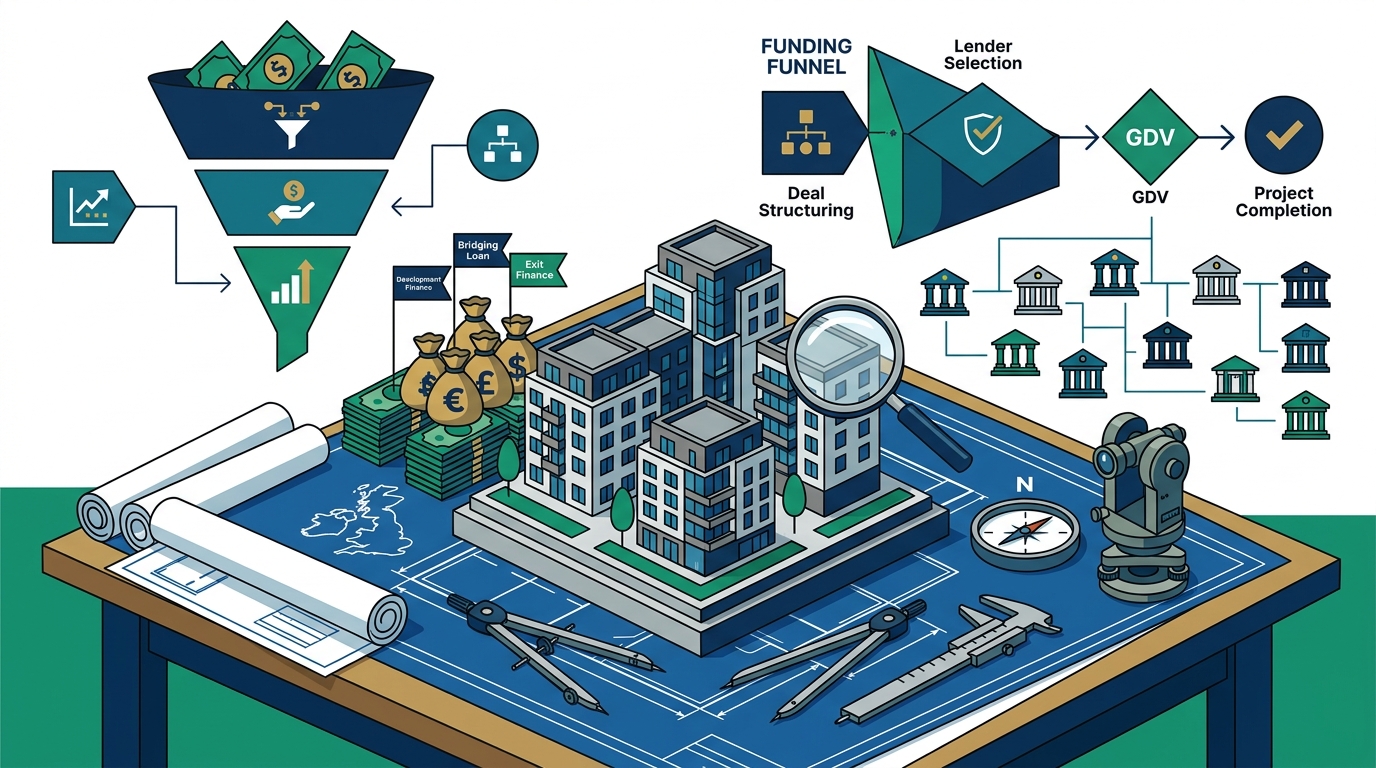
A specialist broker can help translate this information into a structure that reflects how commercial credit teams assess risk. Developer Money Market describes its service as independent and whole of market, with support from initial assessment and lender selection through to completion. For more information, visit its Independent Finance Broker Services page.
2. Build a realistic development appraisal
Lenders need to see not only how much money is required, but also whether the completed scheme can repay the debt if costs, values, or timescales change. A development appraisal should therefore be detailed enough to test the project under less favourable conditions.
Include every material cost
Your appraisal should normally include the acquisition price or land value, stamp duty where applicable, planning and design fees, surveys, legal costs, finance costs, construction costs, utilities, building control, warranties, marketing, sales costs, insurance, contingency, and any VAT exposure. Omitting apparently minor items can materially distort the profit margin.
Support the GDV with evidence
GDV is the estimated market value of the completed development. It should be supported by local comparable evidence, an experienced valuation professional, sales agent feedback, or a combination of these. Avoid relying solely on optimistic asking prices. A lender may reduce the valuation or apply a conservative view of sales values, particularly where the scheme involves unusual units, a weak local market, or limited comparable evidence.
Use sensible contingencies
Construction projects can encounter ground conditions, specification changes, contractor variations, utility delays, and planning complications. A credible contingency demonstrates that the appraisal has been stress-tested rather than built around a best-case scenario. The appropriate allowance depends on the project type, construction method, site condition, and stage of development.
Understand loan-to-cost and loan-to-value
Loan-to-cost (LTC) compares the facility with the total project cost. Loan-to-value (LTV) compares borrowing with the value of the land, property, or completed development. A lender may also assess loan-to-GDV, especially where the proposed debt is repaid from unit sales or a refinance.
Some specialist structures may offer up to 100% LTC, but that does not mean every project will receive full funding or that no contribution is required. The lender may expect the borrower to fund certain costs, provide additional security, contribute land equity, pay interest from separate resources, or accept a joint venture or mezzanine structure. Treat maximum figures as possible parameters, not guaranteed terms.
3. Match the funding structure to the project
The “best” finance is the structure that gives the project enough capital to complete while keeping the cost, risk, security, and repayment terms manageable.
Senior development finance
Senior development finance is usually the primary facility for new builds, conversions, and substantial redevelopment. It can fund eligible acquisition and construction costs, with drawdowns commonly released in stages as works progress. Repayment may come from unit sales, a refinance, or another agreed exit.
Developer Money Market lists senior, stretch senior, mezzanine, and joint venture options, with funding for residential, mixed-use, commercial, leisure, agricultural, and industrial developments. Its website also references projects including new builds, conversions, permitted development schemes, barns, HMOs, hotels, student accommodation, care homes, retirement projects, and part-built developments. ([developermoneymarket.com](https://www.developermoneymarket.com/?utm_source=openai))
Stretch senior finance
Stretch senior finance increases the amount advanced by a single senior lender compared with a conventional senior facility. It may reduce the need for separate mezzanine funding, although the pricing and lender requirements can be higher.
Mezzanine finance
Mezzanine finance sits behind the senior lender and can provide additional capital where the senior facility and the developer’s equity do not cover the full requirement. It may be useful for schemes with a strong underlying margin but a significant equity gap. Because it is subordinated, it is usually more expensive and requires careful modelling of total finance costs.
Joint venture funding
A joint venture may be appropriate where the developer brings the site, planning expertise, project management, or sourcing ability but lacks sufficient cash equity. The funding partner contributes capital in return for an agreed share of profits or another negotiated economic interest. The legal documentation, decision-making rights, profit waterfall, security, and treatment of cost overruns must be understood before proceeding.
Developer Money Market promotes access to 100% joint venture funding for suitable projects. This should be assessed on a case-by-case basis because a fully funded structure can involve sharing profit, granting control rights, or accepting different risk and reporting obligations.
Bridging finance
Bridging finance is generally used where speed or timing is more important than a conventional long-term facility. Examples include auction purchases, land acquisitions with a short completion deadline, property purchases requiring works before refinance, and funding gaps caused by delayed sales or refinancing.
Development exit finance
Development exit finance can replace or repay the original development facility once a project has reached a qualifying stage, such as practical completion or near-completion. It may reduce the pressure to sell units quickly and provide additional time to achieve a suitable sale or arrange long-term investment finance.
| Finance type | Typical purpose | Important consideration |
|---|---|---|
| Senior development finance | Land acquisition and construction | Usually drawn in stages and repaid from sales or refinance |
| Stretch senior | Higher leverage through one senior facility | May carry higher pricing or stricter conditions |
| Mezzanine finance | Filling the gap behind senior debt | Total finance cost and repayment priority must be modelled |
| Joint venture funding | Projects where the developer has limited equity | Profit sharing and governance need specialist legal advice |
| Bridging finance | Fast purchases, timing gaps, or short-term works | A credible refinance or sale exit is essential |
| Development exit finance | Repaying development debt after or near completion | Valuation, completion status, and refinanceability are central |
4. Prepare a lender-ready application
Good deal packaging reduces avoidable questions and helps the lender focus on the commercial merits of the proposal. It does not guarantee approval, but incomplete or inconsistent information can create delays and undermine confidence.
Documents commonly requested
- Completed development appraisal and sources-and-uses schedule.
- Planning permission, drawings, reports, and relevant correspondence.
- Evidence of site ownership or the proposed acquisition terms.
- Detailed build cost plan and contractor quotation.
- Contractor information, including experience, accounts, and insurance.
- Professional team details, including architect, project manager, quantity surveyor, and solicitor.
- Borrower and company identification documents.
- Personal and company assets-and-liabilities statements.
- Property and business borrowing schedules.
- Bank statements or evidence of available equity.
- Sales evidence, appraisals, or a proposed investment refinance strategy.
- Details of adverse credit, litigation, insolvency history, or previous project issues.
Explain weaknesses before the lender finds them
Past credit problems, planning amendments, delayed projects, contractor changes, or cost increases do not automatically make a case impossible. However, they should be disclosed with a clear explanation and mitigation plan. A short, factual narrative is more useful than leaving the lender to discover the issue during underwriting.
Clarify the security position
Property development finance is commonly secured against the development site and may involve additional security, debentures, guarantees, or charges over other assets. Some lenders may consider options without a personal guarantee in particular circumstances, but availability depends on the borrower, project, leverage, lender policy, and overall risk. Never assume that a no-PG option will be available merely because it appears in a product description.
Use an experienced deal packager
A broker with development finance experience can present the proposal in a format that makes the key credit points easy to identify: requested facility, borrower contribution, cost-to-complete, GDV, margin, programme, security, and exit. Developer Money Market states that it packages deals in a way intended to help lenders respond faster and more effectively. ([developermoneymarket.com](https://www.developermoneymarket.com/?utm_source=openai))
5. Choose lender fit over a headline rate
The UK development finance market includes banks, challenger banks, private lenders, bridging specialists, mezzanine providers, family offices, and joint venture investors. Each may have different preferences regarding project size, geography, property type, borrower experience, leverage, planning status, construction method, and exit.
Questions to ask about lender suitability
- Does the lender fund the property type and location?
- Will it consider a first-time developer or require previous completed schemes?
- Can it fund the project at its current stage, including a part-built site?
- How does it treat land value and borrower equity?
- Will it fund professional fees, VAT, contingency, and interest?
- What is the drawdown process and monitoring requirement?
- Are there minimum loan sizes or maximum exposure limits?
- How does the lender handle cost overruns and programme extensions?
- What are the arrangement fees, exit fees, monitoring fees, legal costs, valuation costs, and default charges?
- Is the proposed exit acceptable and independently supportable?
The National Association of Commercial Finance Brokers states that its member brokers have access to UK bank and non-bank lender information, including lender specialisms and relevant contacts. It also describes NACFB membership as a way for borrowers to identify brokers operating within recognised professional standards. ([nacfb.org](https://nacfb.org/broker-lender-engagement/?utm_source=openai))
Developer Money Market says it is an approved NACFB member and works with more than 120 specialist lenders. A borrower should still check the broker’s permissions, fee arrangements, lender panel, scope of service, and the exact terms that apply to the proposed transaction. ([developermoneymarket.com](https://www.developermoneymarket.com/?utm_source=openai))
Consider geographic and property-type appetite
Funding may be available across England, Wales, Scotland, and Northern Ireland, but lender appetite is not uniform. A scheme in a prime regional city, coastal location, rural area, or smaller market may be assessed differently. The same applies to unusual assets such as agricultural conversions, care accommodation, hotels, student schemes, mixed-use buildings, and permitted development projects.
6. Understand what happens after indicative terms
Indicative terms are not the same as a binding finance commitment. The lender will normally carry out valuation, legal, planning, technical, financial, and compliance due diligence before issuing final documents.
Typical stages
- Initial assessment: The broker or lender reviews the project, borrower, funding requirement, and proposed exit.
- Indicative terms: Potential lenders provide non-binding terms subject to due diligence.
- Application and credit review: The selected lender assesses the full proposal.
- Valuation and monitoring: Independent professionals review value, build costs, programme, and progress assumptions.
- Legal due diligence: Solicitors investigate title, planning, searches, security, corporate structure, and loan documentation.
- Formal offer: The lender issues a facility offer subject to conditions and required documents.
- Completion: Legal conditions are satisfied, security is registered or ready to register, and funds are released.
- Drawdowns: Construction funding is typically released against certified progress and agreed conditions.
Well-prepared cases can receive initial feedback quickly, but completion times vary. A straightforward transaction may progress in a matter of weeks, while complex title, planning, valuation, construction, or borrower issues can take longer. Build contingency into the acquisition and construction timetable rather than relying on the shortest possible completion estimate.
Protect the exit from the start
The exit should be credible when the application is submitted, not invented after the loan is approved. For a sales exit, consider unit pricing, absorption rates, marketing strategy, sales costs, and whether reservations or pre-sales are realistic. For a refinance exit, consider rental demand, debt serviceability, lease arrangements, valuation assumptions, and the likely requirements of the next lender.
7. Worked example: financing a six-unit conversion
Imagine a developer wants to acquire a former commercial building and convert it into six residential apartments. The proposed costs are:
- Acquisition: £600,000.
- Construction and conversion: £700,000.
- Professional fees, surveys, and statutory costs: £120,000.
- Finance, marketing, and other costs: £130,000.
- Contingency: £100,000.
- Total project cost: £1,650,000.
- Estimated GDV: £2,250,000.
The initial gross margin before tax and other adjustments is £600,000. A lender will not assess that figure in isolation. It may test whether the GDV is supported by comparable sales, whether the conversion budget is independently credible, whether the contractor can deliver the works, and whether the proposed sales exit remains viable if values fall or costs rise.
If a senior lender offered £1,300,000, the developer would need to fund the remaining project requirement through equity, land value, mezzanine finance, or a joint venture. The best structure would depend on the borrower’s available capital, the lender’s leverage limits, the cost of each funding layer, the developer’s experience, and the desired ownership and profit outcome.
This example illustrates why comparing interest rates alone can be misleading. A cheaper senior facility may require substantially more equity, while a higher-leverage structure may produce a better cash-on-cash outcome but leave less margin after finance costs.
Key takeaways
- Prepare the scheme before approaching lenders: A clear appraisal, planning position, cost plan, programme, and exit make the proposal easier to assess.
- Use realistic GDV and costs: Conservative assumptions are more credible than aggressive figures designed only to maximise leverage.
- Match the product to the project: Senior, stretch senior, mezzanine, joint venture, bridging, and exit finance solve different problems.
- Compare total facility economics: Review interest, arrangement fees, exit fees, monitoring costs, legal costs, valuation costs, and extension charges.
- Do not treat maximum LTC as a promise: The available leverage depends on the full risk profile and lender conditions.
- Disclose complications early: Adverse credit, planning issues, title defects, cost overruns, and previous project problems should be explained rather than concealed.
- Check the exit: The repayment strategy is as important as the initial acquisition and construction funding.
- Consider specialist advice: An independent broker can compare lender appetite and package the case for the most appropriate market segment.
- Clarify fees and conflicts: Ask how the broker is paid, whether there are upfront charges, and whether any exclusivity applies.
Frequently asked questions
What is the best way to obtain property development finance in the UK?
The most reliable process is to create a complete development appraisal, confirm planning and construction assumptions, define a credible exit, and approach lenders whose criteria match the scheme. An independent specialist broker can help compare suitable lender options rather than submitting the same application indiscriminately.
How quickly can development finance be arranged?
Indicative terms may be available within days when the proposal is well presented. Completion commonly takes several weeks, but the exact timetable depends on valuation, legal work, planning, technical due diligence, lender workload, and the complexity of the project.
Can a first-time developer obtain development finance?
Yes, although the lender may require a stronger professional team, an experienced contractor or development manager, a lower leverage level, additional security, or a joint venture partner. A first-time developer should demonstrate relevant property, construction, project management, or investment experience wherever possible.
Is 100% loan-to-cost development finance available?
Some specialist lenders may offer structures described as up to 100% LTC, and joint venture or layered funding may cover the full project cost in suitable cases. However, terms are case-specific. The borrower may still need to contribute fees, provide security, offer land equity, or share profits.
Can development finance be arranged without a personal guarantee?
Some lenders may consider no-personal-guarantee structures, particularly for certain experienced borrowers, leverage levels, or larger transactions. Availability is not universal, and a lender may seek alternative security or impose different commercial terms.
What property types can be funded?
Depending on the lender, funding may be available for residential new builds, conversions, HMOs, permitted development projects, mixed-use schemes, commercial property, hotels, student accommodation, care homes, retirement schemes, agricultural conversions, leisure assets, industrial projects, and part-built developments.
Should I use bridging finance or development finance?
Bridging is generally more suitable for short-term acquisitions, auction purchases, refurbishment, or timing gaps where speed is critical. Development finance is normally designed for a construction or major conversion programme with staged drawdowns and a longer project timeline. Some schemes use bridging initially and refinance onto development finance after planning or acquisition milestones are achieved.
Does Developer Money Market charge an upfront fee?
Developer Money Market states that it operates without upfront fees and that its commission is paid by the lender on successful completion. Confirm the current fee structure, any lender-paid commission, and any transaction-specific costs before proceeding.
Does development finance cover Scotland, Wales, and Northern Ireland?
Funding availability depends on the individual lender, but Developer Money Market states that it sources finance across England, Wales, Scotland, and Northern Ireland, as well as selected international locations including Gibraltar and the Channel Islands.
Discuss your development finance requirement
The right funding structure depends on the site, planning position, total cost, GDV, borrower profile, available equity, security, and exit. Developer Money Market provides a managed start-to-finish service for new and experienced developers, investors, and housebuilders seeking development finance, bridging finance, mezzanine funding, joint venture capital, and development exit finance.
Its stated lender network includes more than 120 specialist lenders and over 320 finance products, with potential funding from £25,000 to £150 million depending on the transaction and lender criteria. These figures are indicative of the broker’s stated market access, not a guarantee that every product or loan size will be available for every applicant. ([developermoneymarket.com](https://www.developermoneymarket.com/?utm_source=openai))
Explore property development finance options or contact Developer Money Market to discuss your project, funding gap, and proposed exit.