

Securing funding is one of the most critical steps in any property development project. Whether you are planning a ground-up new build, a residential conversion, or a commercial refurbishment, the finance you choose will shape your project timeline, profit margin, and overall risk. In the UK, developers can access a wide range of specialist lending products, from senior debt and mezzanine loans to bridging finance and joint venture partnerships. This guide walks you through each stage of the funding process so you can approach lenders with confidence and secure the right deal for your scheme.
Understanding Property Development Finance
Property development finance is a short-term funding product, typically available for 9 to 30 months, designed to cover the purchase and construction costs of residential, commercial, or mixed-use projects. Unlike a standard mortgage where lending is based on a property's current value, development finance is assessed against the Gross Development Value (GDV), which is the estimated open market value of the completed scheme.
Funds are released in staged drawdowns tied to verified construction progress rather than as a single lump sum. This project-focused underwriting model allows developers to fund schemes far larger than their personal balance sheets would normally support. In 2026, specialist lenders and debt funds now provide over 30% of residential development funding in the UK, making alternative finance a mainstream choice for SME developers.
Types of Funding Available
There are several distinct funding products that property developers can use, each designed for a specific stage or need within a project.
Senior Development Finance
Senior debt is the primary loan facility for most development projects. Lenders typically advance up to 60-65% of total project costs, secured by a first charge on the development site. This is the most competitively priced layer of the capital stack. You can explore property development finance options to see how senior debt works in practice.
Mezzanine and Stretch Finance
Mezzanine finance is a hybrid of debt and equity used to fill the gap between your senior loan and available cash. Development stretch funding combines senior debt and mezzanine into one facility from a single lender, avoiding complex inter-lender agreements and enabling developers to spread capital across more projects.
Bridging Loans and Development Exit Finance
Bridging finance is a short-term loan used to secure opportunities quickly, for example when purchasing at auction or acquiring a site ahead of planning approval. Development exit finance is a specialist product for developers who have completed a scheme but need additional time to sell units or arrange long-term refinancing. Both are available through platforms like the Developer Money Market lender comparison tool.
What Lenders Look For
Understanding lender criteria before you apply will dramatically improve your chances of approval and the terms you receive.
Project viability: A detailed appraisal demonstrating profitability, including land cost, build cost, professional fees, finance costs, and a target profit margin of 20-30% on GDV.
Developer experience: Your track record matters. Experienced developers with proven completions can secure rates 100 to 150 basis points below first-time operators, according to industry analysis from FD Commercial.
Security and exit strategy: Lenders need confidence in the asset offered as collateral and a clear repayment plan, whether that is selling completed units, refinancing onto a term mortgage, or retaining as investment stock.
Planning status: While planning permission is not always required to secure finance, having it in place will improve your terms considerably. Always include a contingency budget of 5-10% of total project costs.
Step-by-Step Process to Secure Funding
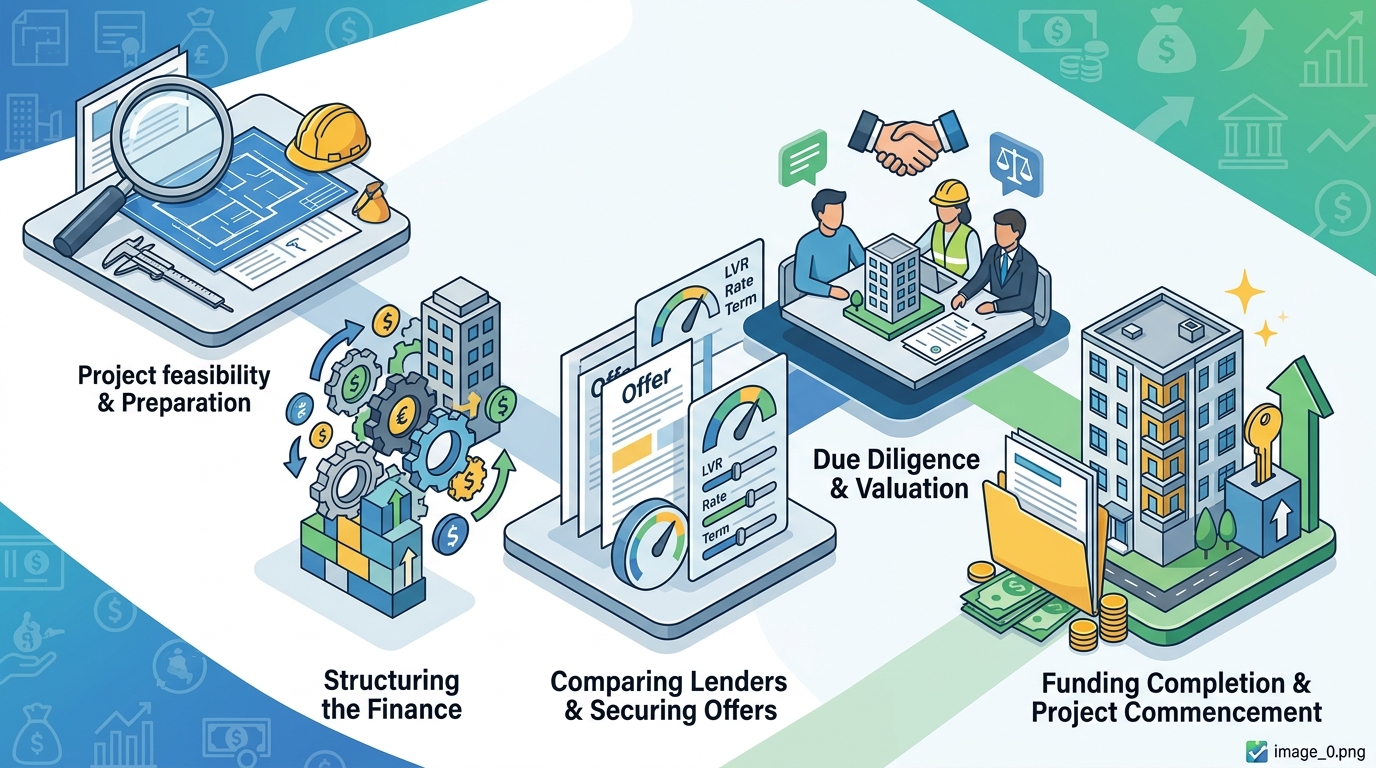
Follow these steps to move from project idea to drawdown efficiently:
- Identify and appraise your opportunity. Run a development appraisal to confirm the scheme is financially viable before committing to any site acquisition.
- Prepare your documentation. Gather architectural plans, cost estimates, planning status, a project timeline, and evidence of your development track record.
- Engage a specialist broker early. The best time to speak with a broker is the moment you identify a development opportunity, not after you have already committed. A broker like Developer Money Market can search over 320 loan products from 120+ specialist lenders on your behalf.
- Compare lending products. Evaluate offers on interest rate, fees, loan-to-cost ratio, drawdown flexibility, and exit conditions, not just headline rate.
- Submit your application. Your broker will package your requirements into a professional presentation that sells the project to lenders.
- Receive valuation and indicative terms. The lender instructs a surveyor to assess the site and proposed scheme, then issues formal terms.
- Complete legal due diligence and draw down. Once solicitors are satisfied, funds are released in staged tranches as construction progresses.
Funding Structures Compared
The table below compares the main development funding structures available to UK developers in 2026:
| Funding Type | Typical LTC | Typical LTV (GDV) | Term | Best For |
|---|---|---|---|---|
| Senior Debt | Up to 65% | Up to 60-65% | 9-24 months | Standard new builds and conversions |
| Stretch Finance | Up to 85% | Up to 70% | 12-24 months | Developers wanting a single lender facility |
| Mezzanine Finance | Top-up to 90% | Up to 75% | Aligned with senior | Bridging the equity gap alongside senior debt |
| Bridging Loan | Varies | Up to 75% | 1-12 months | Quick acquisitions, auction purchases |
| 100% JV Funding | 100% | Profit share | Project-dependent | Developers lacking cash equity with strong track record |
| Development Exit | N/A | 70-75% | 3-18 months | Completed schemes needing sales time |
Each structure carries different cost and risk profiles. Selecting the right combination depends on your equity position, project size, and experience level.
Why Use a Specialist Finance Broker
Many specialist lenders in the property development space do not work directly with borrowers. Independent brokers have established relationships with these institutions, giving you access to funding options you would not find on your own. A broker understands the nuances of the lending market: who is active, who is competitive, and which lenders suit specific deal types.
Working with a broker also reduces the administrative burden. From preparing documentation to liaising with lenders, they act as a central point of contact, ensuring your application progresses smoothly. Read more about why using a broker for property development loans can materially improve the terms you secure.
Developer Money Market provides access to over 320 loan products from more than 120 specialist lenders, covering England, Scotland, Wales, Northern Ireland, and beyond. Their technology-driven platform enables developers to compare property finance lenders quickly and receive tailored solutions with no upfront fees.
Key Takeaways
- Property development finance is assessed on projected GDV, not current property value, enabling developers to fund larger schemes.
- Senior debt, mezzanine, stretch, bridging, and JV funding each serve different stages and equity positions within a project.
- Lenders evaluate project viability, developer track record, security, and exit strategy before approving funding.
- Most UK lenders cap borrowing at 65-70% of GDV, though experienced developers can access higher leverage through stretch or mezzanine products.
- Including a 5-10% contingency budget in your appraisal is expected by lenders and protects against cost overruns.
- Engaging a specialist broker early gives you access to lenders who do not deal directly with borrowers and can improve your terms significantly.
- In 2026, alternative and specialist lenders provide over 30% of UK residential development funding, making broker-led comparison more important than ever.
Frequently Asked Questions
What is property development finance?
Property development finance is a short-term funding product designed to cover the purchase and build costs of residential or commercial development projects. It is typically available for 9 to 36 months and assessed against the Gross Development Value of the completed scheme.
How much can I borrow for a development project?
Most lenders offer loans covering 60-85% of total project costs depending on the product type. Senior debt typically covers up to 65% of costs, while stretch and mezzanine facilities can push total borrowing to 85-90% of costs, subject to a GDV cap of around 70-75%.
Can I get 100% funding for a property development?
Yes, 100% funding is possible through joint venture arrangements where the lender funds the entire project in exchange for a share of the profits. You will need a strong track record and a project with a minimum target return on GDV of around 23%. Learn more about 100% property development finance.
What is Gross Development Value (GDV)?
Gross Development Value is the estimated total market value of a completed development project. It is the primary metric lenders use to determine how much they will advance, typically lending up to 65-75% of GDV.
How long does it take to secure development finance?
Timelines vary, but funds are generally available within two to eight weeks of a formal offer, depending on how quickly you provide documentation and how soon the lender's surveyor can complete a valuation.
Do I need planning permission before applying?
Not always. Some lenders will consider applications for sites without full planning consent, but having planning permission in place will significantly improve your terms and widen the pool of available lenders.
What is the difference between bridging finance and development finance?
Bridging finance is a short-term loan typically used for acquisitions or light refurbishment, with terms of 1 to 12 months. Development finance is specifically structured for ground-up construction or major conversion projects, with staged drawdowns over 9 to 30 months linked to build progress.
Why should I use a broker instead of going directly to a lender?
A specialist broker has relationships with dozens of lenders, many of whom do not accept direct applications. Brokers can compare products across the whole market, negotiate better terms, and manage the application process from start to finish, saving you time and often money.
Get Started With Your Development Funding
If you are planning a property development project and need to secure competitive funding, Developer Money Market can help. With access to over 320 loan products from 120+ specialist lenders and no upfront fees, you can compare your options and receive tailored advice from an experienced team. Call 01244 953360 or start comparing lenders online today.