

Securing funding for a new property development project is one of the most critical steps in turning a site opportunity into a profitable build. Whether you are a first-time developer or an experienced housebuilder, understanding the finance landscape, preparing a strong application, and choosing the right lender can save you thousands of pounds and weeks of delays. Property development finance is a specialist form of short-term funding designed to cover land acquisition, construction costs, and professional fees for residential, commercial, or mixed-use schemes. In this guide we walk through every stage of the funding process so you can move forward with confidence.
1. Understand the Types of Development Finance Available
Before approaching any lender you need to know which funding product suits your project. The UK market offers several distinct structures, each designed for different scenarios and risk profiles.
Senior Development Finance
Senior debt is the primary first-charge facility that funds the bulk of land acquisition and typically 100% of build costs. Most lenders release funds in staged drawdowns that align with construction milestones verified by an independent monitoring surveyor.
Mezzanine and Stretch Finance
Mezzanine finance is a second-charge loan that bridges the gap between your senior facility and your available equity. Stretch funding combines senior and mezzanine into a single facility, simplifying administration while achieving a higher loan-to-cost ratio.
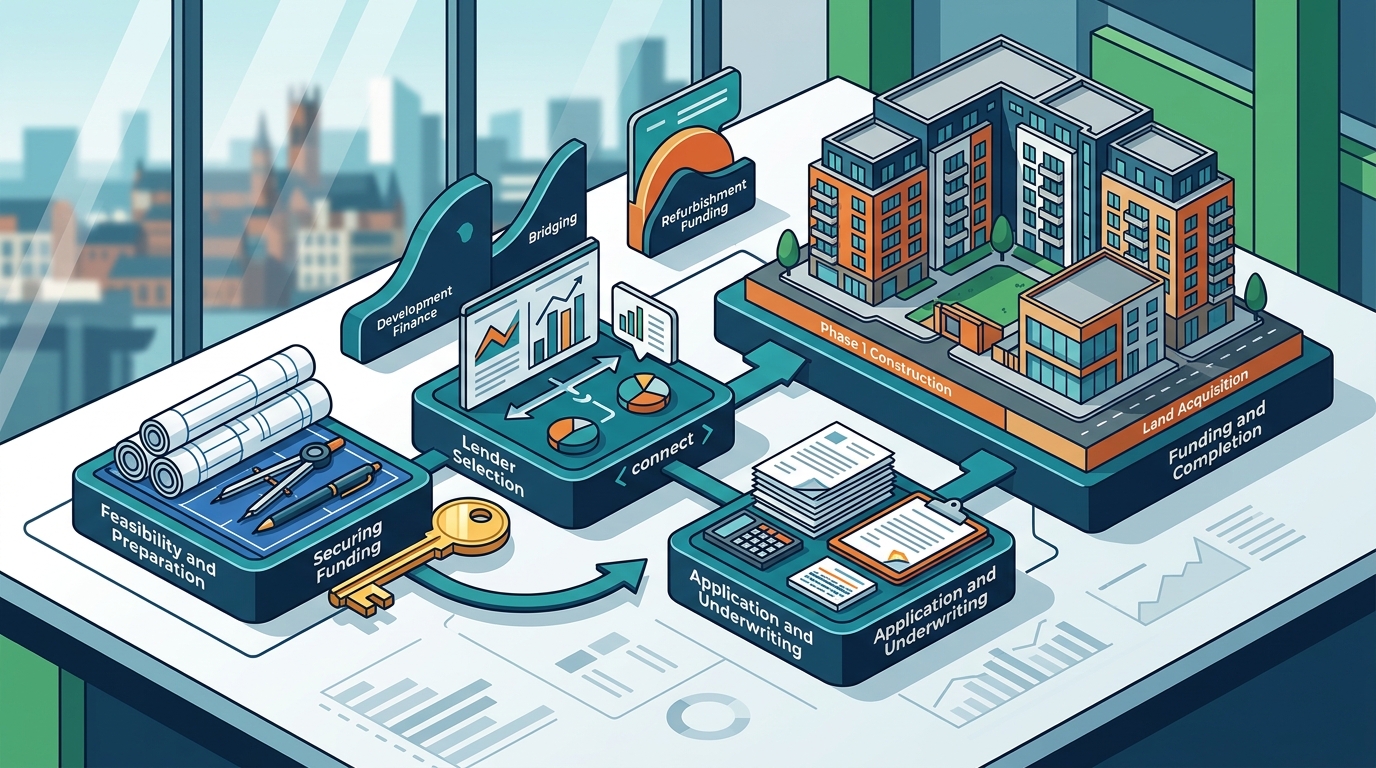
Bridging and JV Funding
Bridging finance is a short-term loan used to secure a site quickly, often before planning consent is obtained. A 100% joint venture (JV) development loan allows experienced developers to proceed without contributing personal equity, with the lender funding acquisition, build, and professional costs in exchange for a profit share.
| Finance Type | Typical LTC | Term | Best For |
|---|---|---|---|
| Senior Debt | 60-70% | 12-24 months | Standard ground-up builds |
| Stretch Senior | 75-85% | 12-24 months | Developers with limited equity |
| Mezzanine | Up to 90% | 12-24 months | Filling the equity gap |
| Bridging | Up to 75% LTV | 3-12 months | Fast site acquisition |
| 100% JV | 100% | 12-36 months | Experienced developers, no cash deposit |
2. Assess Your Project Feasibility
Lenders will scrutinise your numbers before anything else. A clear feasibility appraisal should demonstrate that the project delivers a minimum profit on cost of around 20% for residential schemes. Key metrics include Gross Development Value (GDV), total project cost, and the resulting loan-to-GDV ratio.
Planning status matters enormously. A site with full planning permission attracts far more competitive terms than one relying on permitted development rights or an outline consent. If you are buying land without planning, development bridging finance can help you secure the site while you pursue consent.
3. Prepare a Strong Funding Application
Successful applications require comprehensive business plans, detailed cost projections, and credible sales projections supported by professional market analysis. Lenders evaluate four core pillars: project viability, developer experience, creditworthiness, and exit strategy.
What Lenders Want to See
- Detailed build cost breakdown with contingency (typically 5-10%)
- Professional valuation or Red Book appraisal
- Architect drawings and planning documents
- Evidence of your track record or a strong professional team
- A clear exit route, whether sale of units, refinance, or development exit finance
First-Time Developers
Lenders are more cautious with first-time developers, but practical steps can strengthen your position. Building a strong professional team, including an experienced architect, builder, and project manager, carries significant weight. A fixed-price build contract also reduces lender risk. Consider a lower loan-to-value, as sub-50% LTV is more achievable if you already own the site.
4. Choose the Right Lender or Broker
There are over 120 specialist property development finance lenders in the UK, each with their own appetite for project type, location, facility size, and developer experience. Targeting the right funder is crucial because a mismatched application wastes time and can harm your credibility.
Working with a specialist independent finance broker gives you access to the full market. Developer Money Market, for example, maintains a database of over 320 loan products from more than 120 lenders covering England, Scotland, Wales, Northern Ireland, the Channel Islands, and Gibraltar, with facilities ranging from £25,000 to £50 million. A broker relationship can materially improve the terms you secure by packaging your application professionally and matching it to lenders most likely to approve.
5. Understand Costs, Rates, and Loan Structures
Development finance interest rates in 2026 reflect a settled but higher floor following Bank of England base rate movements. Rates vary considerably depending on loan type, LTV, and developer experience. Senior debt for experienced developers with LTV below 70% typically sits around 6.5-7% per annum, while mezzanine rates can range from 15-24% per annum due to the higher risk profile.
Beyond interest, expect arrangement fees of 1-2% of the facility amount, monitoring surveyor fees, legal costs, and a broker fee upon successful placement. Interest is usually rolled up and repaid at the end of the term rather than serviced monthly, preserving your cash flow during construction.
6. From Application to First Drawdown
Once you have selected a lender and submitted your application, the process typically follows these stages:
- Initial assessment - The lender reviews your headline figures and issues an indicative term sheet.
- Valuation and due diligence - An independent valuer inspects the site and confirms GDV. Legal due diligence runs in parallel.
- Credit committee approval - The lender's credit team formally approves the facility.
- Legal completion - Solicitors finalise the facility agreement, charges are registered, and conditions precedent are satisfied.
- Day-one drawdown - Funds for land acquisition (if applicable) are released. Subsequent build drawdowns follow as construction milestones are certified.
Coordinating valuation and legal processes early reduces delays. A good broker will manage this timeline and keep all parties aligned throughout.
Key Takeaways
- Property development finance is a specialist short-term funding product, not a standard mortgage. Understanding the difference is essential.
- Choose between senior debt, stretch, mezzanine, bridging, or JV funding based on your equity position and experience level.
- A feasibility appraisal showing at least 20% profit on cost is the starting point for any lender conversation.
- Prepare a professional application with detailed costs, planning documents, valuations, and a credible exit strategy.
- First-time developers can improve their chances by assembling an experienced professional team and accepting lower leverage.
- A specialist broker with access to 120+ lenders saves time, improves terms, and packages your application to maximise approval chances.
- Factor in arrangement fees (1-2%), monitoring costs, and legal fees alongside the headline interest rate when comparing products.
Frequently Asked Questions
What is property development finance?
Property development finance is a specialised form of short-term funding designed to support the acquisition, construction, and completion of residential and commercial development projects. Unlike traditional mortgages, these products accommodate the unique cash flow patterns of development activity, with staged drawdowns aligned to build milestones.
How much deposit do I need for development finance?
Most lenders in 2026 expect developers to contribute around 10-30% of total project cost as equity. On lower-risk residential schemes with strong numbers, senior debt plus mezzanine can cover up to 85-90% of costs, but lenders still expect genuine capital from the developer.
Can I get development finance as a first-time developer?
Yes, though terms will reflect the additional risk. Building a strong professional team, securing a fixed-price build contract, and considering a lower LTV (sub-50%) all help. Drawing on related professional experience in construction, architecture, or project management also strengthens your application.
What is a development exit loan?
A development exit loan is a finance product used to repay your development facility once construction is complete but before all units have sold. It typically offers lower rates than development finance and frees your capital to start the next project sooner. You can compare development exit lenders to find competitive terms.
How long does it take to secure development finance?
A standard development finance application takes 4-8 weeks from submission to first drawdown. Bridging loans can complete faster, sometimes in 10-24 days, making them ideal for time-sensitive acquisitions.
What is Gross Development Value (GDV)?
Gross Development Value is the estimated market value of a completed development project, including all units and any commercial space. Lenders use GDV to calculate loan-to-GDV ratios, which typically cap at 60-65% for senior debt facilities.
Do I need planning permission before applying?
Not always, but having planning permission significantly improves your terms and widens the pool of available lenders. If you need to acquire a site before planning is granted, bridging finance can provide the short-term capital while you pursue consent.
Why should I use a development finance broker?
A specialist broker has relationships with dozens of lenders, understands their individual appetites, and can match your project to the most suitable products. They also package your application professionally, saving time and increasing your chances of approval. Developer Money Market provides start-to-end support from initial inquiry through to first drawdown.
Get Started Today
Ready to secure funding for your next property development? Compare over 320 development finance products from the UK's leading specialist lenders in just a few minutes. Developer Money Market's experienced team will guide you from feasibility through to completion, with no upfront fees.