

Securing funding for a multi-unit development project in the UK requires a clear understanding of the finance structures available and how each one suits different project sizes, developer experience levels, and equity positions. Whether you are building a block of flats, converting a commercial property into apartments, or developing a phased housing scheme, the right finance structure can significantly affect your profitability and cash flow. This guide breaks down the leading development finance options for multi-unit projects, compares their key features, and explains how to choose the best fit for your next scheme.
What Is Multi-Unit Development Finance?
Multi-unit development finance is a specialist short-term funding product designed to cover the land acquisition and construction costs of projects that deliver multiple residential or commercial units. Unlike a standard mortgage, this type of lending is assessed against the Gross Development Value (GDV), which is the projected open market value of all completed units.
According to UK Government housing supply data, the country still delivers only around 230,000 homes annually against a target of 340,000, creating strong ongoing demand for multi-unit residential development funding. Lender appetite is currently strongest for schemes of 5 to 50 units in commuter belts and core regional cities such as Manchester, Leeds, and Birmingham.
Senior Development Finance (Senior Debt)
Senior debt is the most common form of development finance for multi-unit projects. It is a first-charge loan secured against the development site, with funds drawn down in stages as construction progresses. Most lenders cap borrowing at 60 to 70% of GDV, with loan-to-cost ratios of up to 85 to 90% for experienced developers.
Interest is typically rolled up into the facility and repaid on completion or as individual units are sold. On multi-unit developments, the outstanding debt reduces with each completed unit sale, which means your finance costs actively decrease as you sell through the scheme. This staged repayment structure is a key advantage for multi-unit projects over single-unit builds.
Developer Money Market provides access to over 320 property development finance products from more than 120 specialist lenders, covering senior debt facilities from £25,000 to £50 million.
Stretch Finance for Higher Leverage
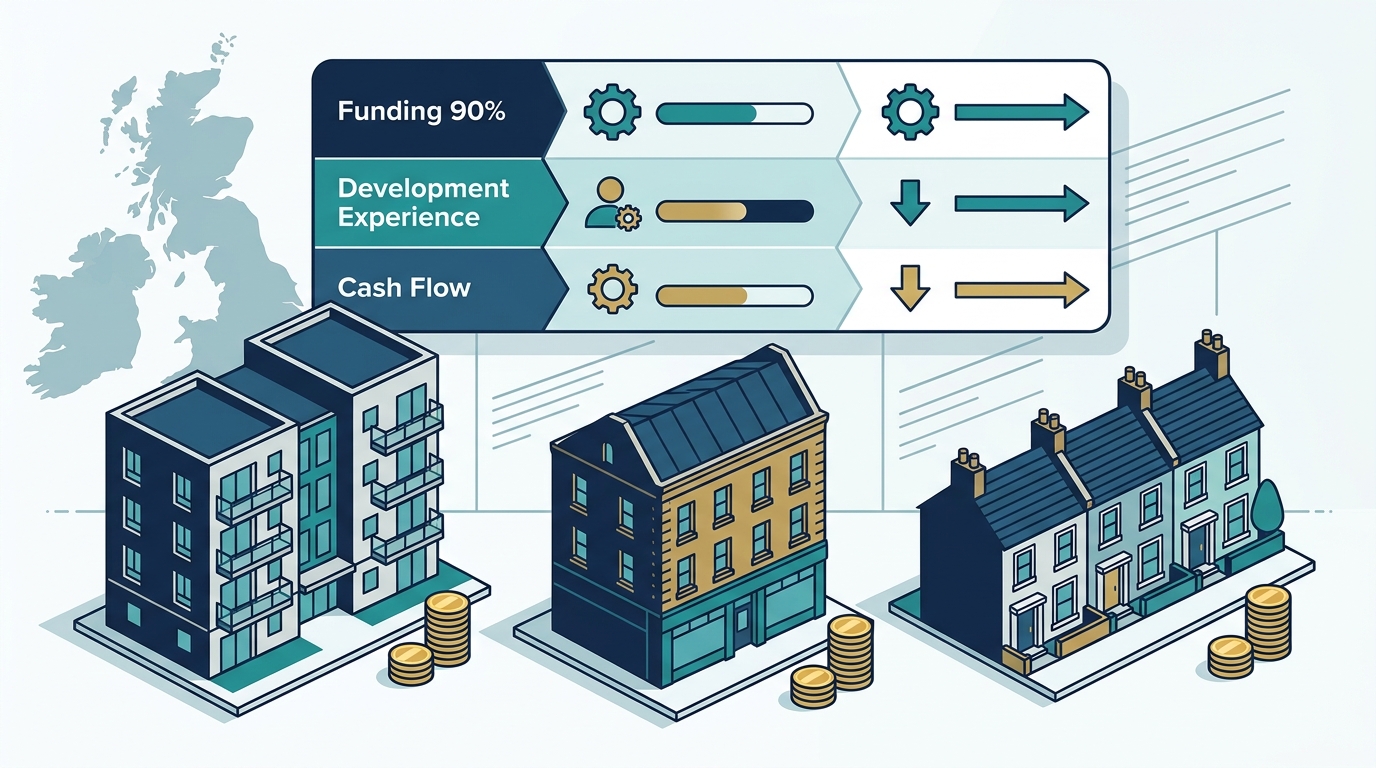
Stretch finance is a single-facility loan that provides a higher loan-to-cost ratio than traditional senior debt, typically up to 80 to 85% of total project costs. It is structured as one loan from a single lender, avoiding the complexity of layering separate debt facilities. This makes it particularly useful for developers who have limited equity to contribute but still want competitive terms.
Stretch funding can help a developer obtain a higher loan to cost than traditional development finance. Learn more about how the stretch funding structure works and the criteria required to qualify.
Mezzanine Funding to Bridge the Equity Gap
Mezzanine finance is a second-charge loan that sits behind the senior debt facility to bridge the gap between what a senior lender will provide and the equity a developer has available. If a senior lender offers 65% of total costs and the developer can only contribute 10%, mezzanine finance can fill the remaining 25%.
Because mezzanine lenders take on higher risk through a subordinated charge, interest rates are typically higher, ranging from around 15 to 24% per annum. Most providers require developers to demonstrate a successful track record and contribute a minimum of 10% of build costs as their own equity. Explore the criteria for raising mezzanine funding in detail.
100% Joint Venture (JV) Funding
Joint venture development finance is a funding structure where a lender or investment partner provides up to 100% of the acquisition, build, and professional costs. The developer does not need to contribute cash equity, making it an attractive option when capital is tied up in other projects.
JV facilities between £500,000 and £4 million are the most common, but funding up to £20 million is possible. Developers will need to demonstrate significant experience and a proven track record. Profits are typically split between the developer and the JV funder, often around 50:50. Developer Money Market is a specialist in JV property development finance and can help source bespoke solutions.
Bridging Finance for Site Acquisition
Bridging finance is a short-term loan, typically lasting 3 to 12 months, used to secure a development site quickly before longer-term development finance is arranged. It is particularly useful for acquiring land at auction or before planning permission has been granted. A typical use case for multi-unit developers is to bridge a site purchase and then refinance into a full development facility once planning consent is secured.
Developer Money Market's bridging finance service connects developers with a large panel of specialist lenders offering fast decisions and competitive terms from 0.65% per month.
Development Exit Finance
Development exit finance is a short-term loan designed for developers who have completed or nearly completed a scheme but need additional time to sell units or arrange long-term refinancing. Typical loan terms run from 3 to 18 months. For multi-unit projects, this facility allows developers to repay a more expensive development loan while selling remaining units at full market value, rather than accepting discounted offers to meet facility deadlines.
LTV norms for mainstream residential exit facilities currently sit at around 70 to 75% of the completed scheme value. You can compare development exit finance lenders directly through Developer Money Market's online platform.
Finance Options Compared
| Finance Type | Typical LTC / LTV | Term | Best For | Equity Required |
|---|---|---|---|---|
| Senior Debt | Up to 65-70% GDV | 12-24 months | Experienced developers with equity | 20-35% |
| Stretch Finance | Up to 80-85% LTC | 12-24 months | Developers needing higher leverage | 15-20% |
| Mezzanine | Up to 90% LTC (combined) | 12-24 months | Bridging the equity gap | 10%+ |
| 100% JV | Up to 100% of costs | 12-36 months | Experienced developers, no cash available | 0% |
| Bridging | Up to 75% LTV | 3-12 months | Quick site acquisition | 25%+ |
| Development Exit | Up to 75% LTV | 3-18 months | Selling remaining units post-build | Varies |
Key Takeaways
- Multi-unit development finance is assessed on Gross Development Value (GDV), not current site value.
- Senior debt is the most widely used option, typically capping at 65 to 70% of GDV with staged drawdowns.
- Stretch finance offers higher leverage through a single facility, reducing the complexity of layered debt.
- Mezzanine funding fills the gap between senior debt and developer equity, though at higher interest rates of 15 to 24% per annum.
- 100% JV funding enables experienced developers to proceed without contributing cash equity, with facilities commonly ranging from £500,000 to £4 million.
- Bridging finance is essential for fast site acquisitions, particularly before planning consent is in place.
- Development exit finance helps multi-unit developers sell remaining units at market value rather than accepting discounts to meet loan deadlines.
Frequently Asked Questions
What is development finance for multi-unit projects?
Development finance for multi-unit projects is a specialist short-term loan designed to fund the land purchase and construction costs of schemes delivering multiple residential or commercial units. Lending is assessed against the projected value of the completed development, known as the Gross Development Value (GDV).
How much can I borrow for a multi-unit development?
Most senior lenders advance up to 65 to 70% of the GDV, with loan-to-cost ratios of up to 85 to 90% for experienced developers. By combining senior debt with mezzanine or stretch finance, total leverage can reach 90% or more of total project costs.
Can I get 100% funding for a multi-unit scheme?
Yes, through 100% joint venture (JV) development finance. JV lenders provide all acquisition, build, and professional costs. However, you will need to demonstrate significant development experience and accept a profit-share arrangement with the funder.
What interest rates should I expect in 2026?
Development finance rates in the UK in 2026 typically sit between 0.65% and 1.10% per month, or roughly 8% to 13% per annum, depending on scheme risk, developer experience, and leverage. Mezzanine rates are higher, typically 15 to 24% per annum.
How does bridging finance help with multi-unit development?
Bridging finance allows developers to quickly secure a development site, often before planning permission is obtained, and then refinance into a full development facility once consent is granted. Typical terms run from 3 to 12 months.
What is development exit finance?
Development exit finance is a short-term loan for developers who have completed or nearly completed a scheme but need extra time to sell units or arrange long-term refinancing. It replaces a more expensive development loan, giving breathing space to achieve full market value on remaining sales.
Do I need development experience to secure multi-unit finance?
Most senior lenders prefer developers with a proven track record for multi-unit schemes. However, first-time developers can access funding by partnering with experienced contractors, using specialist lenders, or starting with smaller projects to build experience. A specialist broker like Developer Money Market can help match you with lenders suited to your profile.
Why should I use a specialist development finance broker?
A specialist broker provides access to a wider panel of lenders, structures your application professionally, and saves significant time compared to approaching lenders individually. Developer Money Market offers access to over 320 loan products from more than 120 specialist lenders, with an online comparison platform that matches your project to suitable funding options.
Get Started with Your Multi-Unit Finance Search
Finding the right development finance for a multi-unit project does not have to be complex. Developer Money Market's free online loan search platform lets you compare over 320 loan products from more than 120 specialist lenders in just a few minutes. Enter your project details, review matching products, and apply with one click. No upfront fees. No obligation. Start your search today.